Mr.Saturator
Mr.Saturator plugin — saturator with three parallel analog modes.
Introduction
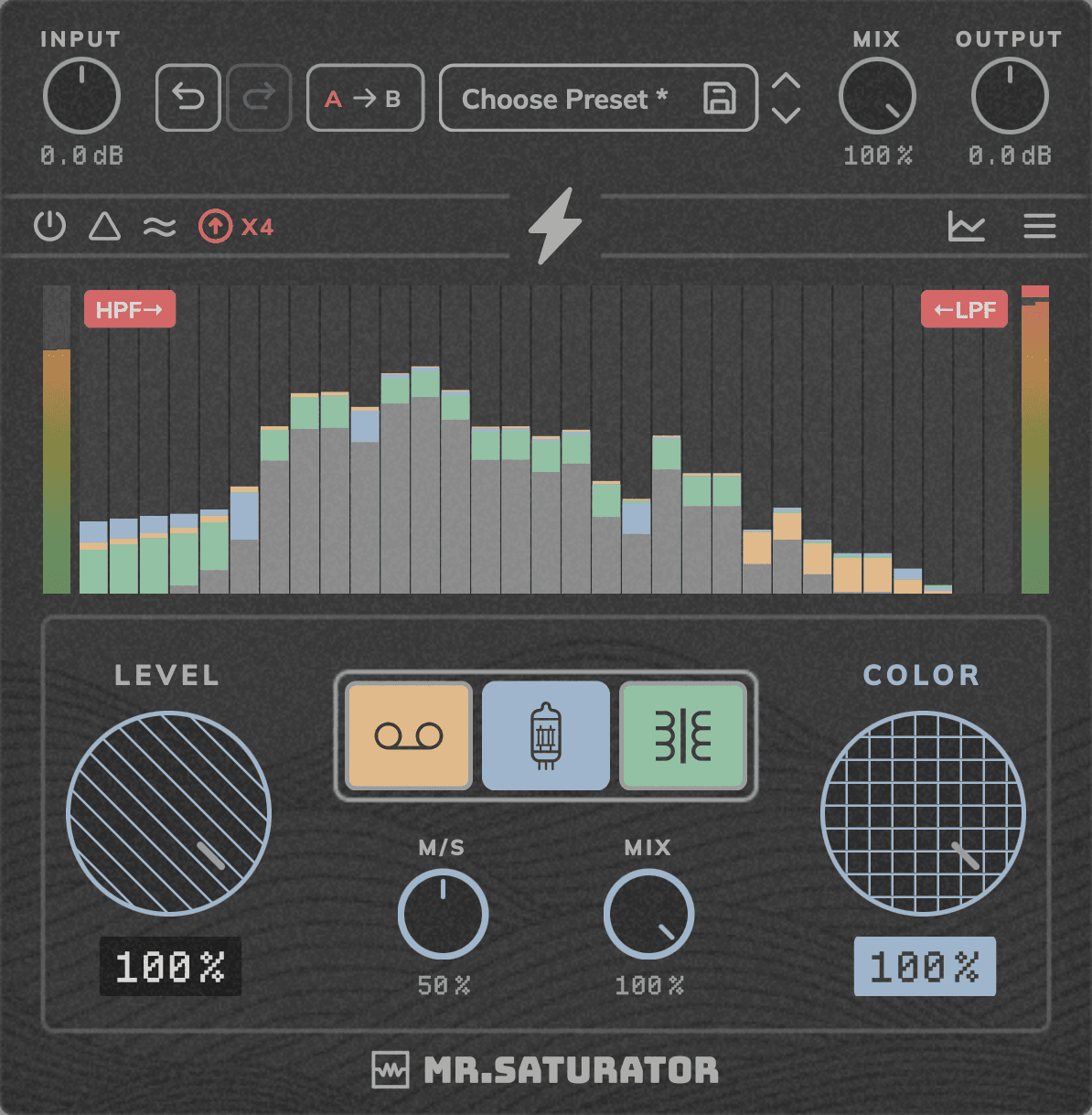
Mr.Saturator is a multi-mode saturator that combines three analog stages in parallel — Tape, Tube and Transformer — each with its own level, color, mix and Mid/Side balance. It includes HPF/LPF filters to focus saturation on a chosen band, oversampling up to x8, RMS gain match, a global dry/wet Mix and a Delta monitor to hear exactly what the plugin adds.

Installation
- Download MrAppManager from the INSTALLATION PAGE, or the installer with all three plugins if you'd rather not use the app.
- Open MrAppManager, go to Plugins and click Install on Mr.Saturator, or run the installer.
- Open your DAW and find Mr.Saturator in the plugin list (VST3 / AAX; AU on macOS).
- Insert Mr.Saturator on the desired channel's effects chain.
Interface
Mr.Saturator is split into three independent saturators (Tape, Tube, Transformer) that process in parallel, plus a global section with filters, oversampling, Mix and gain controls.
Tape / Tube / Transformer (Enable): Toggles each saturator independently. The three can run in parallel, blended through their own Mix controls.
Mix (global): Global blend between the original (dry) signal and the whole processed chain (wet). 100% = processed signal only.
HPF / LPF: High-pass and low-pass filters (SVF) that limit the band where saturation acts. Signal outside that range stays clean.
Input / Output Gain: Input gain to drive the saturation stage harder, and output gain to make up the resulting level.
Boost: Drives the Color stage with extra intermodulated harmonics for a more aggressive, creative character.
Oversampling: Raises the internal sample rate (x1, x2, x4 or x8) to reduce aliasing introduced by saturation.
RMS Match: Matches the output RMS to the input so you can A/B the effect without level differences.
Delta: Monitor mode that plays only the difference between input and processed signal — useful to hear exactly what the plugin adds.
Bypass: Disables processing while keeping latency compensated for click-free A/B.
Chart type: The bars/curve icon above the graph toggles two visualization modes: Bars (third-octave style analyzer) and Curve (smoothed spectral curve). It doesn't affect the sound — visual only.
Menu: Click the hamburger icon (top right) to open the menu: Theme (Classic / Dark) switches the UI palette; Resize (75 / 100 / 125%) scales the plugin window; Help opens Website, Support, About and License.
Level (per saturator)
Controls the amount of saturation applied by each mode. The higher the level, the more harmonics and natural compression.
Color (per saturator)
Shapes the harmonic balance of each saturator. Lets you fine-tune the character of each stage independently.
Mix (per saturator)
Wet/dry blend for that specific mode. Lets you dose each saturator in the parallel sum.
M/S (per saturator)
Mid/Side balance per saturator: 0% processes only Mid, 50% full stereo, 100% only Side.
How Mr.Saturator saturates
The three modes run in parallel on Mid and Side. Tube and Transformer are not fixed curves (waveshapers): they are models with memory — capacitors that charge and a magnetic core with hysteresis — so the harmonic content changes with the dynamics and the frequency of what goes in. Tape keeps its odd-harmonic generator built on Chebyshev polynomials.
Tape — filtered Chebyshev
Generates odd harmonics with Chebyshev polynomials, very similar to the harmonics produced by the Tascam 388. Part of them go through a low-pass, so the distortion gets darker in the top end. Color adds more higher-order harmonics.
Tube — 12AX7 triode
Physical model of a 12AX7 in a common-cathode stage, with its input and cathode capacitors. When the grid conducts, the operating point shifts (bias shift), so the saturation is asymmetric, with even and odd harmonics, and changes with the envelope. Level and Color set how much voltage reaches the grid.
Transformer — hysteresis core
Magnetic core with hysteresis following a model in which the output depends on whether the wave is rising or falling, and odd harmonics dominate. A shelf before the core and its inverse after it make the lows saturate first without changing the frequency response, as in a real transformer. Level and Color control the drive.
Boost (lightning)
An extra saturation stage that rounds off the waveform peaks and adds more harmonics. Its bias follows the envelope: the louder the signal, the more even harmonics, the second above all. Its intensity follows the average Color of the active saturators.
Presets
Mr.Saturator ships with factory presets to get you started. You can also save your own settings and organise them by category.
System Requirements
- Formats: VST3, AAX (64-bit) and AU (macOS only)
- Platforms: macOS 10.13 or later on Intel and 11.0 or later on Apple Silicon, and Windows 10 (1607) or later (64-bit)
- No iLok required
- Works with all major DAWs, including Ableton Live, Logic Pro, GarageBand, FL Studio, Cubase, Studio One, Reason, Reaper, Bitwig Studio ...
Release notes
1.1.6 · November 2026
With the HPF at its minimum (20 Hz) the filter is now off, so the lowest frequencies keep their saturation. The interface shows the current values as soon as it opens.
1.0.8 – 1.1.5 · October 2026
MANAGE WITH MrAppManager button to activate from the app; Buy License opens the plugin's page and the support links open the website in your language. Safer activation and trial, confirmed by the server. New tube (triode) processing and Mix control; revised Tape and Transformer processing. On-screen help, switched on from the menu. Interface size (75%, 100%, 125%), remembered between sessions; values show their unit; button hover tooltips removed; color and mode button adjustments. Requires macOS 10.13 or later.
1.0.0 – 1.0.7 · January – September 2026
Development and test versions.