Mr.Spectrum
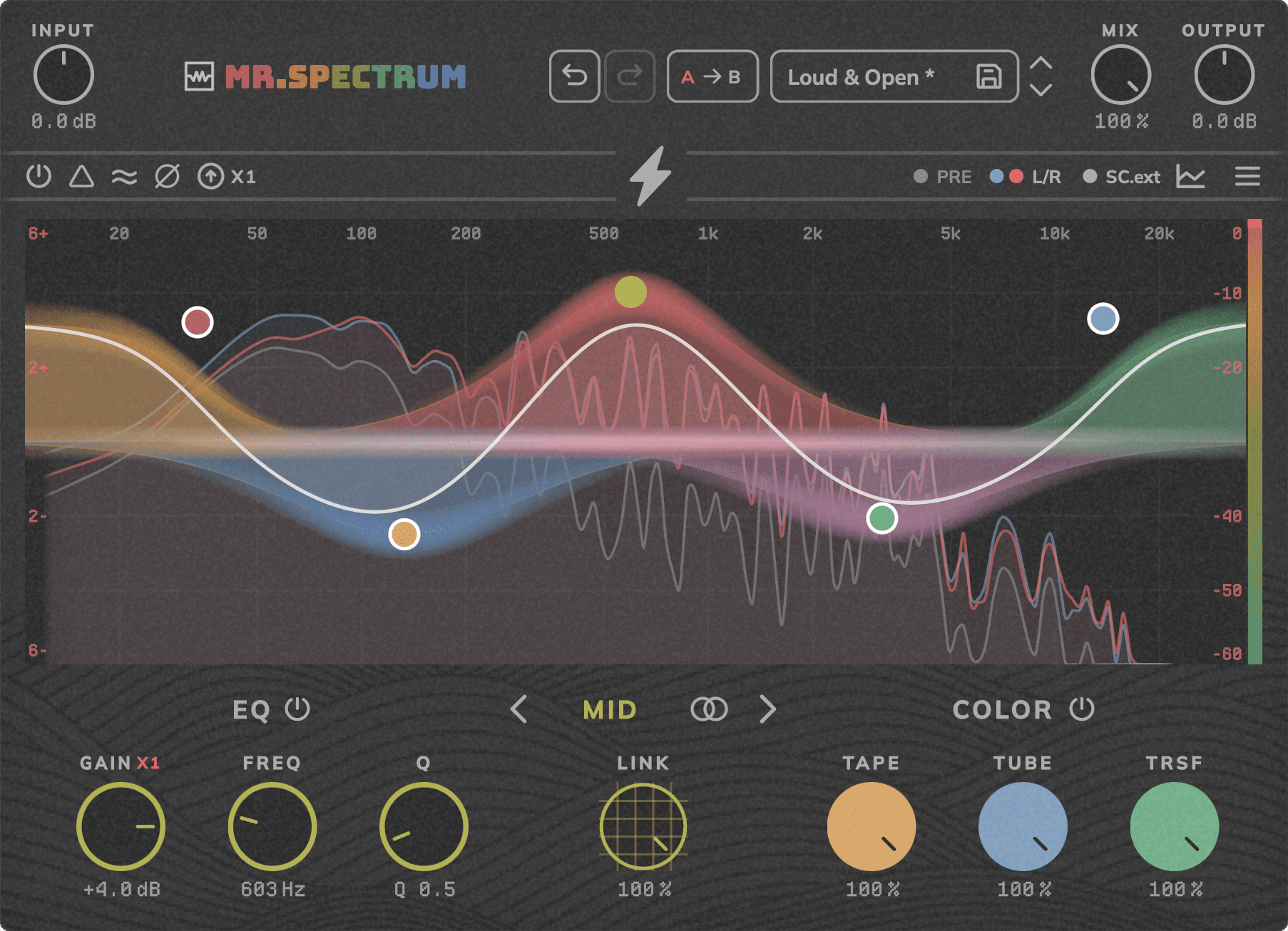
Mr.Spectrum plugin — 5-band parametric EQ with analog saturation per band.
Introduction
Mr.Spectrum is a 5-band parametric equalizer with the option to add three analog saturation modes — Tape, Tube and Transformer — per band. Bands 1 and 5 can act as Peak, Shelf or Pass filters with selectable slope. It includes Linear Phase mode, per-band Mid/Side control, oversampling for the saturation stage, RMS gain match and a Delta monitor.

Installation
- Download MrAppManager from the INSTALLATION PAGE, or the installer with all three plugins if you'd rather not use the app.
- Open MrAppManager, go to Plugins and click Install on Mr.Spectrum, or run the installer.
- Open your DAW and find Mr.Spectrum in the plugin list (VST3 / AAX; AU on macOS).
- Insert Mr.Spectrum on the desired channel's effects chain.
Interface
The interface is built around the spectrum analyzer and the EQ curve, with independent controls per band and a global section for gain, mix and quality.
5 parametric bands: Each band has independent Gain (±dB), Frequency (Hz) and Q controls. Bands 2, 3 and 4 are Peak type. Bands 1 and 5 can switch type.
Band 1 / Band 5 Type: Band 1 can be Peak, Low Shelf or High Pass. Band 5 can be Peak, High Shelf or Low Pass. Useful to clean up edges or shape the overall spectrum.
Band 1 / Band 5 Slope: Pass filter slope for bands 1 and 5 (6, 12, 18 or 24 dB/oct) when used as High Pass or Low Pass.
Band On: Toggles a whole band (its EQ and its saturation) by double-clicking its node on the curve, without losing the settings.
Band Solo: Hovering a node reveals a toolbar with a headphones icon: press and hold to monitor the band while held, or double-click to latch the solo (click again to release). Useful to fine-tune Q and frequency.
EQ On / Sat On (per band): Toggles the EQ or the saturation of the active band independently with their power buttons, without losing the settings.
Per-band saturation (Tape / Tube / Trsf): Each band can add independent Tape, Tube and Transformer saturation with separate amounts. The saturation is applied only within that band's range.
Boost: Pushes the saturation stage with extra intermodulated harmonics for a more aggressive character.
Sat Link EQ: Picks what signal feeds the band's saturation: at 0% it saturates the original signal (pre-EQ), at 100% it saturates the EQ'd signal, and intermediate values blend the two. LETS YOU DECIDE WHETHER THE EQ AFFECTS THE SATURATION.
Per-band M/S: Mid/Side mode per band: applies the band's EQ + saturation to the full stereo signal (Stereo), only the center (Mid) or only the sides (Side). Click to cycle.
Quality EQ: Switches between Zero Latency (real-time) and Linear Phase (no inter-band phase shift, ideal for mastering).
EQ x2 Range: Doubles each band's gain range for more extreme boosts or cuts.
Sat Oversampling: Increases the internal sample rate of the saturation (x1, x2, x4 or x8) to reduce aliasing when driving hard.
Input / Output Gain: Input gain to drive the plugin, and output gain to make up the resulting level.
Mix: Global wet/dry mix between the original signal and the processed one (EQ + saturation).
RMS Match: Matches output RMS to input for clean A/B comparisons without level differences.
Delta: Monitor that plays only the difference between the clean and processed signal — useful to hear exactly what the plugin is doing.
Bypass: Disables processing with compensated latency for clean A/B switching.
Analyzer menu: The chevron icon above the analyzer opens a menu with Speed (Low / Medium / High — analyzer response time), Range (60 / 90 / 120 dB — vertical range) and Tilt (0 / 1.5 / 3 / 4.5 / 6 dB/oct — spectral tilt). Above the graph, the PRE, M/S and SC.ext labels toggle which signals are drawn: pre-EQ, mid/side and external sidechain.
Menu: Click the hamburger icon (top right) to open the menu: Theme (Classic / Dark) switches the UI palette; Resize (75 / 100 / 125%) scales the plugin window; Help opens Website, Support, About and License.
How Mr.Spectrum works
Mr.Spectrum is a linear-phase 5-band equalizer with optional per-band saturation. Being linear-phase, it introduces no phase distortion: transients and stereo image stay intact, ideal for mastering and surgical correction. Each band can saturate with the same models as Mr.Saturator — Tape, Tube and Transformer — with a separate amount for each and no Color control of its own.
Tape — filtered Chebyshev
Generates odd harmonics with Chebyshev polynomials, very similar to the harmonics produced by the Tascam 388. Part of them go through a low-pass, so the distortion gets darker in the top end. Raising the amount also brings in more higher-order harmonics.
Tube — 12AX7 triode
Physical model of a 12AX7 in a common-cathode stage, with its input and cathode capacitors. When the grid conducts, the operating point shifts (bias shift), so the saturation is asymmetric, with even and odd harmonics, and changes with the envelope. The amount sets how much voltage reaches the grid.
Transformer — hysteresis core
Magnetic core with hysteresis following a model in which the output depends on whether the wave is rising or falling, and odd harmonics dominate. A shelf before the core and its inverse after it make the lows saturate first without changing the frequency response, as in a real transformer. The amount controls the drive.
Per-band blend and Boost
A band's active modes are summed weighted by their amounts and normalized by the square root of the summed amounts, and the Boost (lightning) uses the band's highest amount as its Color. Only the difference the saturation creates within the band's range is added to the signal.
EQ-link
Decides which signal feeds the saturation: at 0% it saturates the clean signal (independent of the EQ); at 100% it saturates the signal already processed by the EQ; values in between blend both. Use case: cut a resonance with a narrow filter and, with low EQ-link, let the saturation refill that hole with harmonics from the chosen mode — you keep body and color where the EQ took energy out.
Presets
Mr.Spectrum ships with factory presets to get you started. You can also save your own settings and organise them by category.
System Requirements
- Formats: VST3, AAX (64-bit) and AU (macOS only)
- Platforms: macOS 10.13 or later on Intel and 11.0 or later on Apple Silicon, and Windows 10 (1607) or later (64-bit)
- No iLok required
- Works with all major DAWs, including Ableton Live, Logic Pro, GarageBand, FL Studio, Cubase, Studio One, Reason, Reaper, Bitwig Studio ...
Release notes
1.1.6 · November 2026
The interface shows the current values as soon as it opens.
1.0.10 – 1.1.5 · October 2026
MANAGE WITH MrAppManager button to activate from the app; Buy License opens the plugin's page and the support links open the website in your language. Safer activation and trial, confirmed by the server. New tube (triode) processing; revised Tape and Transformer processing; changes to the linear-phase engine. Volume compensation (RMS match) now accounts for latency; gains stay neutral in bypass. Adjusted factory presets. On-screen help, switched on from the menu. Interface size (75%, 100%, 125%), remembered between sessions; values show their unit; button hover tooltips removed; interface color adjustments. Requires macOS 10.13 or later.
1.0.0 – 1.0.9 · February – September 2026
Development and test versions.